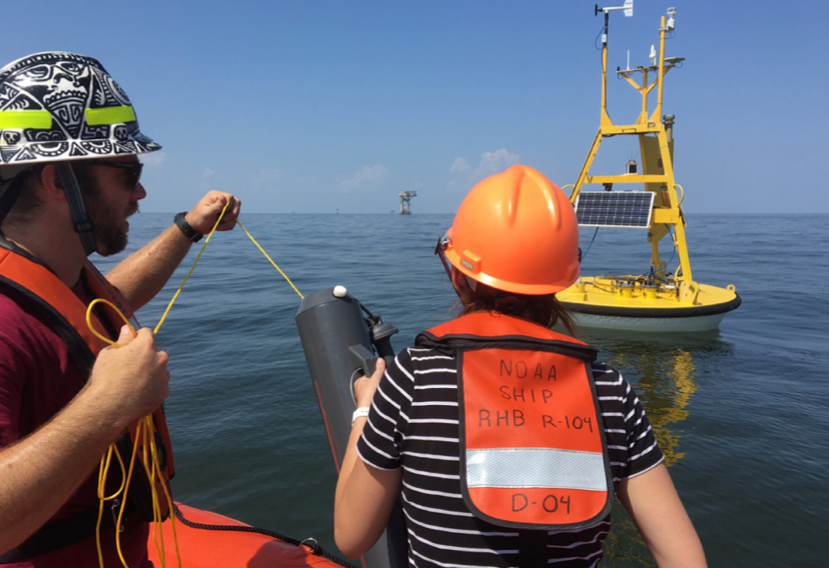
GCOOS is not limited to monitoring of oceanographic and atmospheric physical processes. The ocean chemistry is also monitored as it influences the health of the marine environment that supports marine life on earth and hydrodynamics of the region. The following are the projects that GCOOS is engaged, to monitor long-term change of ocean chemistry.
The Nutrient Sensor Pilot Study is to build a US Gulf Coast array of in situ nutrient sensors towards the goal of high frequency dissolved nutrient monitoring and promote open-source data dissemination through high-frequency quantification, provisional data transmission, and best practice QA/QC protocol development. This is a U.S. EPA supported studies, led by the University of Louisiana-Lafayette, and data contributed by several Gulf-based institutes.
Following on from interagency nutrient sensor work facilitated by the Alliance for Coastal Technologies (ACT), the Gulf of America Nutrient Sensor Project (GoA NSP) launched in 2019. Since 2019, the GoA NSP has integrated commercially available nutrient sensors into existing monitoring programs, testing the utility and operability of extensive, real-time nutrient monitoring arrays. The GoA NSP network of nutrient sensors and monitoring partners has been purpose-built for detection in biogeochemically distinct US Gulf estuaries. Project partnerships facilitate deployment planning and nutrient sensor operation for existing and prospective partners. QA/QC protocols standardized across the project promote integration of data products into shared data management systems.
These activities support the ongoing efforts to advance nutrient sensing in critical ecosystems such as the Gulf of America. With funding from the U.S. EPA through NOAA and GCOOS, researchers in the GoA NSP are working to establish a network of in situ nutrient sensors in coastal and estuarine ecosystems along the US Gulf Coast.
Project partnerships are in varying stages of development, from planning stages to active deployment. Further additions to the GoA Nutrient Sensor network will seek to fill gaps in geographical coverage of the US Gulf Coast. In addition to revealing nutrient dynamics on the Gulf Coast, project partnerships build a community of knowledge around commercialized, in situ nutrient sensors and create relationships between research institutions and sensor technology companies.
Nutrient sensor selection takes advantage of the commercialization of affordable in situ sensors to deploy a cost-effective monitoring network. Three sensors have thus far been identified for lower cost, high accuracy nutrient detection, and we are continually looking for new entries to the market.
In general, wet chemical sensors achieve higher sensitivity and are more resistant to environmental interference, but they require more maintenance and have steeper learning curves. Optical sensors require less maintenance and are more facile to use, but they may be CDOM, salinity, and/or turbidity-limited and tend to have less sensitive detection limits, relative to wet chemical technologies.
The three sensors that will be tested in this phase are TriOS OPUS (optical nitrate sensor), Systea WIZ (wet chemical nutrient sensor) and Green Eyes NuLAB (wet chemical nutrient sensor).
The collection of hypoxia and nutrients data collected in the Gulf of America from 1922 to 2014. This dataset aggregates observations from hypoxia and nutrient data collected by the Mineral Management Service (MMS) of the Department of the Interior from 1922 to 2014.
In early 2013, GCOOS consolidated hypoxia and nutrient datasets originally collected by the Department of the Interior's Minerals Management Service (MMS), which was reorganized into three agencies in 2010. These datasets, spanning 1922 to 2014, were collected from 31,332 sampling sites across the Gulf and published on the GCOOS data portal in late 2014. The compilation of more than 19 million historical data records was initiated by the late Dr. Matthew Howard, who served as Data Manager for GCOOS.
In early 2026, GCOOS revalidated the dataset, culling all entries containing invalid inputs such as incorrect dates, null values or unrealistic measurements. Today, the current dataset includes 19,907,246 validated records from across the Gulf that can provide users with a historic picture of important water quality parameters and the ability to discover how they have changed over time.
| Item |
Count
|
Remarks | |
| Organizations |
80
|
Organizations or departments that reported data to a repository. | |
| Platforms |
31,332
|
Distinct locations where data were collected. | |
| Variable: Chlorophyll |
55,883
|
Chlorophyll-a concentration (mg L-1). | |
| Variable: Dissolved Oxygen |
785,156
|
Dissolved oxygen concentration (mg L-1). | |
| Variable: Enterococcus |
244,727
|
Enterococcus bacteria (counts). | |
| Variable: Fecal coliform |
155,654
|
Fecal coliform bacteria (counts). | |
| Variable: Nitrogen |
44,081
|
Nitrogen (nitrite, nitrate, ammonia and organic nitrogen) concentration (mg L-1) as N. | |
| Variable: pH |
6,307,765
|
Measure of the acidity or basicity of a water sample. | |
| Variable: Phosphorus |
106,956
|
Dissolved Total Phosphorus concentration (mg L-1). | |
| Variable: Salinity |
5,935,560
|
Measure of salt content following UNESCO standards. | |
| Variable: Water temperature |
6,105,235
|
In situ water temperature measured in degrees Celsius. | |
| Variable: Silicate |
45,578
|
Silicate concentration (uM L-1). | |
|
|
|||
| Total observation records |
19,786,595
|
Data on ERDDAP |